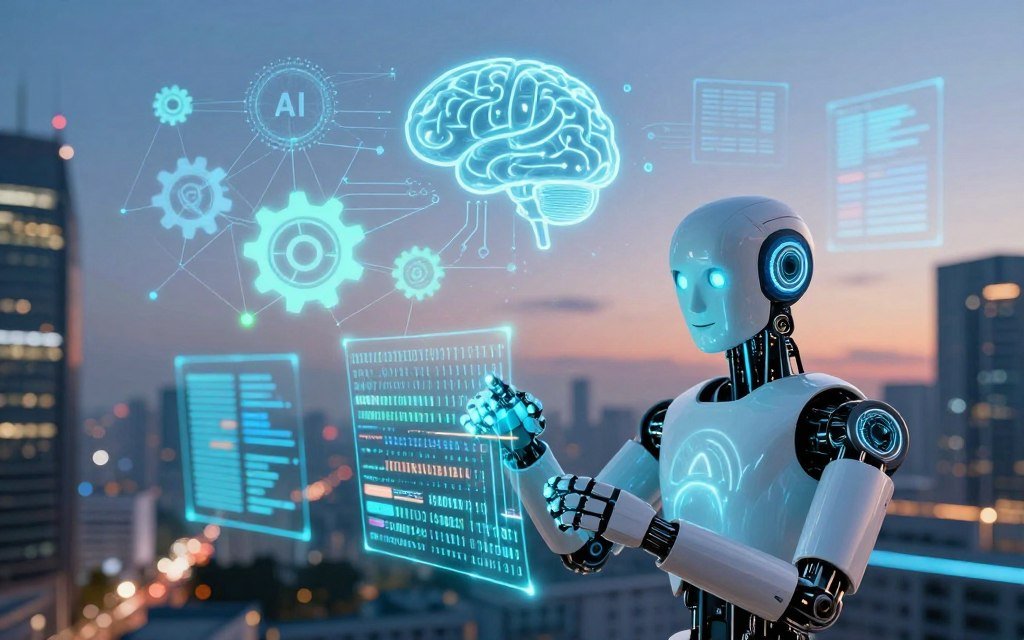
We see AI Work happening behind the scenes of our favorite digital tools. By processing massive amounts of data, these models identify patterns that help computers make decisions.
Many people believe that modern machine intelligence is a form of digital magic. In reality, these systems rely on complex mathematical processes designed to mimic human cognition.

AI Work
Understanding how these systems function helps us appreciate their role in our modern world. From smartphone recommendations to complex online services, AI Work in daily life influences almost every digital interaction we have today.
We invite you to explore the mechanics behind these innovations. By breaking down these technical concepts, we can demystify the technology that shapes our future.
Key Takeaways
- Machine intelligence is based on advanced mathematics rather than magic.
- These systems are designed to simulate human cognitive patterns.
- Data processing allows computers to recognize trends and make predictions.
- Modern technology influences everything from mobile apps to professional services.
- Learning the basics helps users navigate a digital-first society with confidence.
The Fundamental Concept of Artificial Intelligence
We often hear about smart software, but what truly defines the essence of Artificial Intelligence basics? At its core, this field represents a shift in how we design technology to solve complex problems. Instead of just following static commands, these systems aim to replicate cognitive functions that we typically associate with the human mind.

Artificial Intelligence basics
Defining Intelligence in Machines
When we talk about machine intelligence, we refer to the capacity of a computer system to perceive its environment and take actions that maximize its chance of success. This involves more than just processing data; it requires the ability to learn from experience and adjust to new inputs. True intelligence in this context means the system can handle tasks that are not explicitly defined in its original code.
These systems often demonstrate an ability to recognize patterns, solve problems, and even make decisions under uncertainty. By mimicking human-like reasoning, they provide solutions that are both efficient and scalable. This evolution marks a significant departure from the rigid software of the past.
The Difference Between Traditional Programming and AI Work
To understand the leap in technology, we must look at how traditional software functions. Standard programming relies on explicit, rule-based instructions provided by human developers. If a specific scenario is not covered by the code, the program simply cannot handle it.
In contrast, Artificial Intelligence basics involve systems that adapt and improve their performance over time. Rather than following a fixed list of rules, these models use data to identify trends and refine their own logic. This dynamic approach allows machines to handle unpredictable scenarios without needing a human to write new code for every possible outcome.
Ultimately, the transition toward machine intelligence allows us to build tools that grow more capable as they encounter more information. This fundamental difference is what enables modern technology to tackle challenges that were once considered impossible for computers to solve.
How AI Work: The Core Mechanisms
To grasp the power of artificial intelligence, we must examine the building blocks of its operation. While it may seem like magic, the reality is a highly structured process of information processing. We can break down the way AI Work into a series of logical steps that transform raw input into meaningful output.
Data as the Foundation of Learning
The primary fuel for any intelligent system is data. Without vast amounts of information, these systems would have no context to understand the world. We provide these machines with historical records, images, or text to help them identify underlying trends.
This is how AI Work learns to distinguish between different concepts. By feeding the system diverse examples, we allow it to build a comprehensive internal map of reality. The quality of this data directly determines the accuracy of the final results.
Algorithms and Mathematical Models
Algorithms act as the mathematical engine that drives the entire process. These sets of rules allow computers to perform predictive modeling based on the patterns they discover. By applying complex statistics, the software can forecast future outcomes with surprising precision.
“The science of today is the technology of tomorrow.”
Edward Teller
We rely on these models to turn chaotic information into structured insights. Through predictive modeling, the system calculates the probability of various events occurring. This mathematical approach ensures that decisions are based on evidence rather than guesswork.
The Role of Pattern Recognition
Pattern recognition is the final piece of the puzzle. It allows the system to identify correlations that might be invisible to the human eye. By spotting these recurring themes, the software can make informed decisions that appear highly intelligent to the end user.
This capability is essential for understanding how AI learns to adapt to new situations. As the system encounters more data, it refines its ability to detect subtle nuances. Ultimately, the way AI Work relies on this constant cycle of observation, analysis, and refinement.
Machine Learning: Teaching Computers to Learn
At the heart of modern technology lies the fascinating process of teaching computers to learn from experience. By utilizing various machine learning algorithms, we enable systems to improve their performance over time. This evolution in computing changes how AI learns, moving beyond static instructions toward dynamic adaptation.
Supervised Learning Explained
Supervised learning acts like a student working with a teacher who provides the correct answers. We feed the model labeled data, which includes both the input and the expected output. The algorithm then maps these inputs to the correct results to minimize errors.
When comparing supervised vs unsupervised learning, the primary difference lies in the presence of labels. In supervised scenarios, the system learns by example, constantly adjusting its internal parameters to match the provided targets. This method is highly effective for tasks like email spam detection or image classification.
Unsupervised Learning and Hidden Patterns
Unsupervised learning takes a different approach by exploring data without any predefined labels. We provide the machine with raw information, and it must identify hidden patterns or structures on its own. This process is essential for discovering segments in customer data or grouping similar items together.
“The goal of machine learning is to build systems that can learn from data and improve their performance without being explicitly programmed for every task.”
— Anonymous Researcher
Reinforcement Learning Through Trial and Error
Reinforcement learning functions through a system of rewards and penalties. An agent interacts with an environment and makes decisions to achieve a specific goal. If the action leads to a positive outcome, the agent receives a reward, reinforcing that behavior.
This iterative process allows the system to optimize its strategy through constant trial and error. We see this technology applied in complex fields such as:
- Training autonomous robots to navigate obstacles.
- Developing game-playing AI that masters strategy.
- Optimizing resource allocation in supply chains.
Deep Learning and Neural Networks
At the heart of modern AI innovation lies the complex world of deep learning models. These systems represent a significant leap forward in how computers interpret the world around them. By mimicking biological processes, they allow machines to solve problems that were once thought to be exclusive to human cognition.
The Human Brain as an Inspiration
We often look to the biological wonders of the human brain to understand how machines learn today. Scientists designed neural network architecture to mirror the way neurons fire and connect within our own minds. This approach allows software to identify patterns that are far too subtle for traditional programming to detect.
“The brain is a complex system, and by modeling our software after its structure, we unlock new levels of machine capability.”
Layers of Processing in Neural Networks
To process information, these systems utilize multiple AI Work neural layers. Each layer acts as a filter, refining data as it moves through the network. The first layers might identify simple shapes, while deeper layers combine those shapes to recognize complex objects or concepts.
This hierarchical structure is what makes the technology so powerful. By stacking these AI Work neural layers, the system builds an increasing level of abstraction. This allows the computer to understand context, nuance, and even abstract ideas with remarkable precision.
Why Deep Learning Requires Massive Data
Because these systems are so complex, they require massive amounts of data to effectively train. Without a vast library of examples, the neural network architecture cannot learn the necessary patterns to make accurate predictions. This is why the rise of big data has been so critical to the success of modern AI.
Training these deep learning models involves several key steps:
- Gathering diverse datasets to ensure broad coverage.
- Cleaning raw information to remove noise and errors.
- Running iterative cycles to improve accuracy over time.
Ultimately, the combination of high-quality data and sophisticated network design drives the progress we see today. As we feed more information into these systems, their ability to perform tasks continues to grow at an exponential rate.
Natural Language Processing and Generative AI
Language is the primary way we share ideas, and now machines are learning to speak our tongue. We are entering an era where digital systems can interpret, analyze, and respond to human input with remarkable fluency. This shift changes how we interact with technology on a daily basis.
How Machines Understand Human Speech
At the heart of this capability is Natural Language Processing, or NLP. This field of computer science focuses on the interaction between computers and human languages. It allows software to break down complex sentences into structured data that a machine can process.
By identifying syntax, semantics, and context, these systems move beyond simple keyword matching. They learn to grasp the intent behind a user’s query. This makes digital assistants and translation services feel much more natural and helpful.
The Mechanics Behind Large Language Models
To achieve this level of sophistication, developers rely on Large Language Models. These models are trained on massive datasets containing billions of words from books, articles, and websites. They function by calculating the statistical probability of the next word in a sequence.
Through billions of parameters, these models refine their internal logic to predict language patterns with high accuracy. This process is not about “thinking” in the human sense, but rather about advanced pattern recognition. The result is a system that can maintain context over long conversations.
Generating Text and Creative Content
Modern Generative AI tools take these underlying models and apply them to creative tasks. They do not just retrieve information; they synthesize new content based on the patterns they have learned. This allows users to produce high-quality output for various professional needs.
These tools are currently transforming workflows across many industries. Some of their most common applications include:
- Drafting professional emails and reports.
- Writing and debugging complex computer code.
- Summarizing long documents into concise bullet points.
- Creating creative stories or marketing copy.
We see these systems acting as collaborative partners rather than just simple tools. By leveraging the power of these models, professionals can save time and focus on higher-level strategy. The potential for innovation in this space continues to grow every day.
Computer Vision and Sensory Perception
Computer vision technology represents a massive leap forward in how artificial intelligence interacts with our environment. By mimicking the human visual system, machines can now process vast amounts of visual data to make sense of the physical world. This capability allows software to move beyond simple data entry and start interpreting the reality around us.
How AI Work Interprets Images and Video
At its core, visual interpretation relies on breaking down images into numerical values. Every digital image consists of millions of pixels, each containing specific color and brightness information. Algorithms scan these pixels to identify edges, textures, and gradients that form recognizable structures.
When processing video, the system analyzes a sequence of frames to track movement over time. This temporal analysis helps the machine understand not just what an object is, but how it behaves within a scene. Pattern recognition is the engine that drives this entire process, allowing the software to compare visual input against massive databases of known images.
Object Detection and Facial Recognition
Modern systems excel at identifying specific items within a complex frame. Through advanced neural networks, computers can distinguish between a pedestrian, a traffic sign, or a stray animal with incredible speed. This process involves drawing bounding boxes around detected items to categorize them accurately.
“The eyes are the windows to the soul, but for a machine, they are the gateway to understanding the physical world.”
Facial recognition takes this a step further by mapping unique geometric features of a human face. By measuring the distance between eyes, the shape of the jawline, and other distinct markers, the system creates a digital signature. This technology is now widely used for security, device authentication, and personalized user experiences.
Applications in Autonomous Vehicles
The most critical application of these visual capabilities is found in autonomous systems. Self-driving cars must process a constant stream of visual data to navigate busy streets safely. They rely on cameras to detect lane markings, traffic lights, and other vehicles in real time.
These systems must make split-second decisions based on what they perceive. To ensure safety, they often combine visual data with other sensors like LiDAR and radar. This multi-modal approach ensures that the vehicle maintains a clear understanding of its surroundings, even in challenging weather or lighting conditions.
The Training Process: From Raw Data to Intelligence
Transforming raw information into intelligent systems requires a highly structured and rigorous lifecycle. We must treat every stage of development with precision to ensure the final output is reliable and accurate. This journey begins long before the computer starts learning.
Data Collection and Cleaning
The quality of any model is strictly limited by the quality of the AI Work training data we provide. We start by gathering massive datasets from diverse sources, such as public records, sensor logs, or user interactions. However, raw data is rarely ready for immediate use.
This is where data preprocessing becomes essential. We must clean the information by removing duplicates, fixing errors, and normalizing formats to ensure consistency. Without this step, the model might learn from noise rather than meaningful patterns.
Training, Validation, and Testing Phases
Once the data is clean, we divide it into three distinct sets to evaluate performance objectively. This separation prevents the model from simply memorizing the answers, a common pitfall known as overfitting.
- Training Set: The primary data used to teach the model how to recognize patterns.
- Validation Set: Used during the training process to tune parameters and prevent errors.
- Testing Set: A final, unseen batch of data used to verify how well the model performs in the real world.
By keeping these sets separate, we ensure that our AI Work training data leads to a system that can generalize well to new, unseen scenarios. This rigorous testing phase is the backbone of reliable software development.
Fine-Tuning for Specific Tasks
After the initial training is complete, we often use a process called fine-tuning to sharpen the model’s focus. While a base model might understand general concepts, it often needs extra guidance to excel at niche tasks. We feed the model smaller, highly specialized datasets to adjust its internal weights.
This approach allows us to adapt powerful, pre-trained models for specific industries like healthcare or finance. Fine-tuning significantly increases precision and efficiency, turning a general-purpose tool into a specialized expert. Through this final stage, we achieve the high level of performance required for modern applications.
Real-World Impact and Ethical Considerations
As artificial intelligence becomes more integrated into our AI Work in daily life, we must consider the broader implications of its rapid expansion. This technology is no longer a futuristic concept; it is a present-day reality that influences how we access services and make critical decisions. We believe that understanding these impacts is essential for navigating the modern digital landscape.
AI Work in Healthcare and Finance
In the medical field, machine learning models are revolutionizing patient care by assisting doctors with highly accurate diagnostics. These systems analyze complex medical imagery to identify conditions that might be missed by the human eye. Similarly, the financial sector relies on these tools to provide robust fraud detection, protecting our assets by flagging suspicious transactions in real-time.
By automating routine tasks, these industries can focus more on high-level problem solving. This shift allows professionals to dedicate their time to complex cases that require a human touch. We see this as a major step forward in operational efficiency.
Addressing Bias and Transparency
While these advancements are impressive, we must prioritize Ethical AI Work development to ensure fairness for everyone. Algorithms can inadvertently learn prejudices present in historical data, leading to unfair outcomes in hiring or lending. This is why AI Work bias and transparency remain the most critical challenges for developers today.
To build trust, we need systems that are explainable and accountable. When an automated decision affects a person’s life, there must be a clear path to understand how that conclusion was reached. We advocate for rigorous testing protocols to identify and remove hidden biases before systems are deployed.
The Future of Human-AI Collaboration
Looking ahead, we envision a future where technology acts as a powerful partner rather than a replacement. By combining human creativity with machine processing power, we can solve some of the world’s most challenging problems. This synergistic relationship will likely define the next decade of innovation.
Ultimately, the goal of AI Work in daily life is to enhance our productivity and improve our quality of life. As we continue to refine these tools, our focus must remain on creating a future that benefits all of humanity. Through careful oversight and commitment to Ethical AI Work development, we can ensure that technology serves our collective interests.
Conclusion
Artificial intelligence acts as a powerful engine driving modern innovation across every sector. We see this technology reshaping how businesses operate and how individuals interact with the digital world. Understanding the mechanics behind these systems provides us with the clarity needed to navigate a landscape defined by rapid change.
Companies like Google, Microsoft, and OpenAI continue to push the boundaries of what machines can achieve. Our ability to adapt to these advancements determines our success in the coming years. We must remain curious about the tools that influence our daily routines and professional growth.
FAQ’s You Should Know
The primary difference lies in how instructions are processed. In traditional programming, we provide explicit, rule-based instructions for every task. However, Artificial Intelligence basics involve systems that adapt and improve through experience. Instead of being programmed for every scenario, AI uses mathematical processes to learn from data, allowing tools like Microsoft Azure AI to make independent decisions based on the information we provide.
We consider data the “fuel” for machine intelligence. Systems like Google Gemini rely on massive datasets to identify trends and correlations through pattern recognition. Without high-quality AI training data, these models cannot perform accurate predictive modeling. This is why the process of data collection and data preprocessing is critical; we must ensure the information is clean and relevant before the learning process begins.
We categorize machine learning into three distinct methods: supervised learning, where we train models on labeled data; unsupervised learning, which discovers hidden patterns without human guidance; and reinforcement learning, a system of trial and error where agents optimize performance based on rewards. These methods allow platforms like Amazon to personalize recommendations specifically for your shopping habits.
Neural network architecture is biologically inspired by the structure of human neurons. These systems consist of multiple AI neural layers that process information in increasing levels of abstraction. Through deep learning, we enable computers to handle complex tasks, though this requires massive data and significant computational power, often provided by NVIDIA H100 GPUs, to achieve high levels of accuracy.
This is achieved through Natural Language Processing (NLP) and Large Language Models (LLMs). By analyzing billions of parameters, models like OpenAI’s ChatGPT can predict the next word in a sequence with remarkable fluency. We use these tools to generate original text, code, and creative content, transforming how we approach professional communication and software development.
Computer vision is the technology that enables machines to “see” and interpret visual data. By analyzing pixel data for shapes and textures, algorithms perform object detection and facial recognition. We see this technology in action every day with Tesla’s Autopilot system, which allows autonomous vehicles to navigate complex environments in real time by identifying pedestrians, traffic lights, and obstacles.
We follow a rigorous lifecycle that includes validation and testing phases to ensure the model generalizes well to new, unseen information. Once a base model is established, we perform fine-tuning to adapt it for specific tasks. This process is essential for maintaining precision in high-stakes environments, such as healthcare diagnostics or finance fraud detection systems.
We are deeply committed to addressing AI bias and ensuring transparency in automated decision-making. Because AI learns from historical data, it can inadvertently adopt human prejudices. We work to mitigate these issues by focusing on ethical AI development, ensuring that as human-AI collaboration increases, the technology remains a fair and beneficial force for all users.